
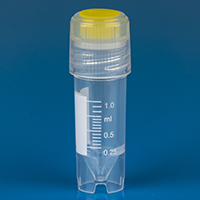
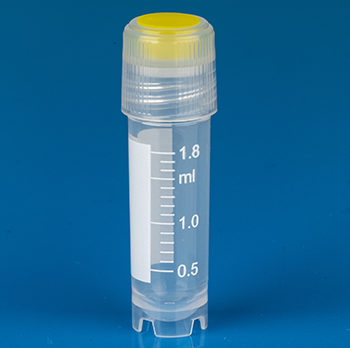
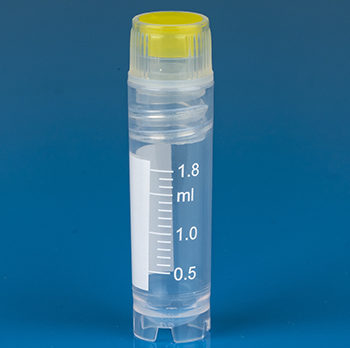
Cryo tubes are made from virgin polypropylene, we offer cryogenic vials with both internal as well as external threading.
Each cryogenic tube is equipped with O-ring made from medical class silicon. It offers leak proof sealing. These cryovials can work very well in the temperatures ranging from 121°C to -196°C.
Both tubes are self-standing but have a conical bottom.
Complete Volume Range: Currently we have 1.0mL and 2.0mL
| Specification | Packaging detail | Cat# |
| 1.0mL/1.2mL Cryo tubes, self-standing, External threads, Nature, sterile, DNase and RNase free, 50 PCS/Bag, 20 Bags/Case | 1000 | MBC.CRY.1.0_EX |
| 1.8mL/2.0mL Cry tubes, self-standing, External threads, Nature, sterile, DNase and RNase free, 50 PCS/Bag, 20 Bags/Case | 1000 | MBC.CRY.2.0_EX |
| 1.8mL/2.0mL Cry tubes, self-standing, Internal threads, Nature, sterile, DNase and RNase free, 50 PCS/Bag, 20 Bags/Case | 1000 | MBC.CRY.2.0_IN |
FAQs
What is a cryo tube and what is it used for?
A cryo tube (also called a cryogenic tube or cryovial) is a specially designed tube that can withstand extremely low temperatures. It is used to store biological samples like cells, DNA, RNA, proteins, or tissue in ultra-low temperature environments such as liquid nitrogen vapor.
What materials and design features make cryo tubes effective?
Cryo tubes are often made of medical-grade polypropylene. They include features like silicone O-rings for leak-proof sealing, external or internal screw threads, and graduations or markings to identify sample volume
What is the difference between internal-thread and external-thread cryo tubes?
External-thread tubes keep the cap threads on the outside, which can reduce contamination risk during handling. Internal-thread tubes have the threads inside the neck. Choice often depends on storage setup and user preference.
What temperature and storage conditions can cryo tubes handle?
Cryo tubes are built to endure ultra-low temperatures—down to about -196 °C in liquid nitrogen vapor phase. However, many manufacturers recommend storing them in vapor phase above the liquid nitrogen rather than direct immersion to avoid sample loss or tube failure.
Are cryo tubes sterile, and are they DNase/RNase-free?
Yes, high quality cryo tubes are usually sterilized (often by gamma irradiation) and certified free of DNase, RNase, and pyrogens, making them safe for sensitive biological samples.
Can I reuse cryo tubes?
Some cryo tubes may be reusable if thoroughly cleaned and sterilized, but that carries a risk of contamination. Many labs prefer to use them as single-use to preserve sample integrity.
How full should I fill a cryo tube when freezing samples?
Leave some headspace. Overfilling can cause pressure build-up, leakage, or even tube damage during freezing and thawing cycles.
Can I ship or use these cryo tubes in places like Calgary, Toronto, Alberta, or Ontario?
Yes, cryo tubes can be shipped to those locations. Laboratories in Calgary, Toronto, Alberta, and Ontario can access them through suppliers who deliver in Canada.
Can I purchase cryo tubes in bulk for my Canadian lab?
Absolutely. Bulk orders are available. Contact your supplier or manufacturer for bulk pricing, minimum quantities, and logistics.
Why choose Max Biochem cryo tubes?
The Max Biochem cryo tubes are built for durability, leak resistance, accurate sample storage in extreme cold, and sample safety. They have robust design features and are suited for long-term cryopreservation use.